
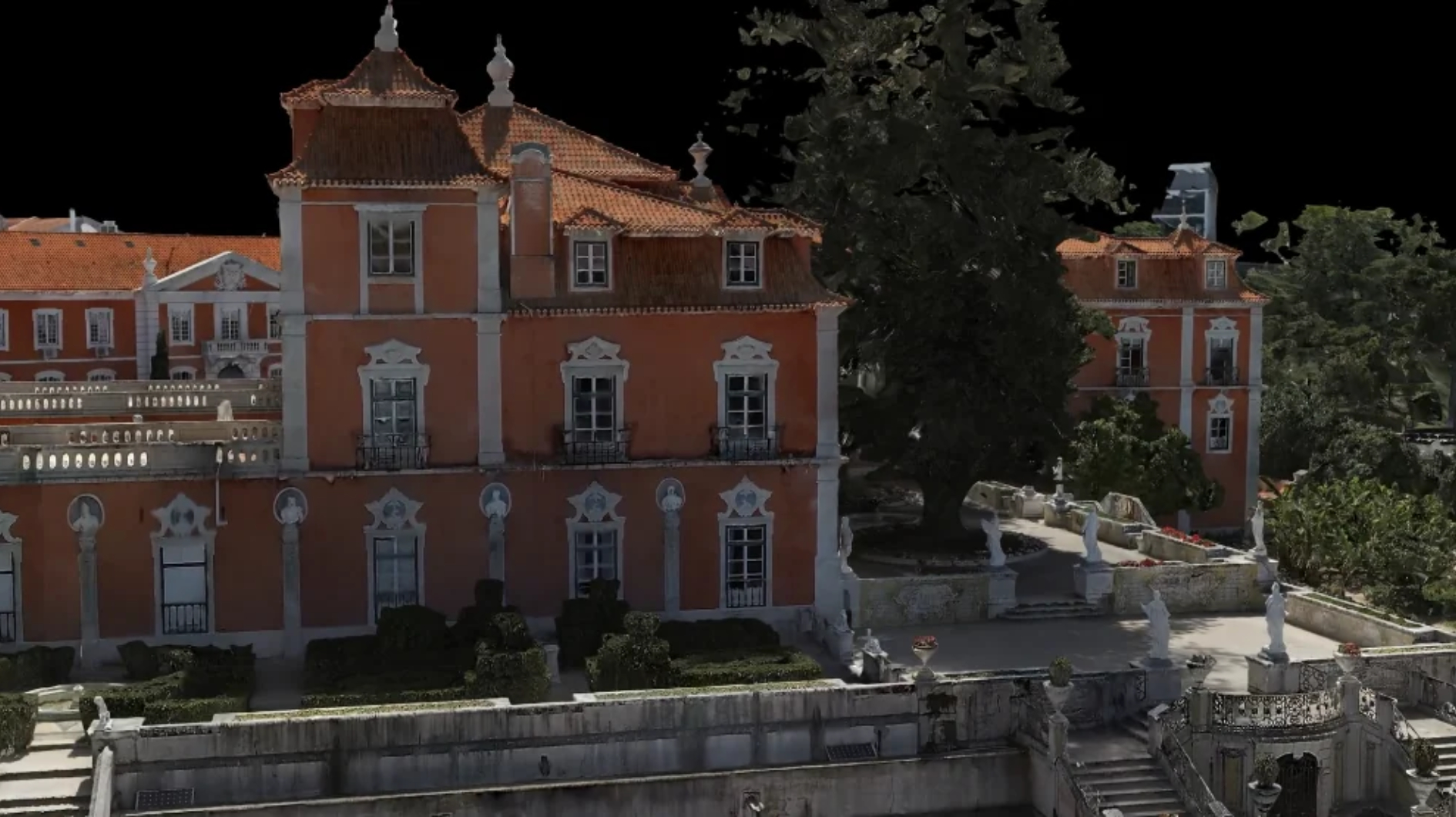
Gaussian Splatting is a 3D reconstruction technology that allows photographs and videos to be transformed into photorealistic, navigable 3D environments.
Unlike conventional 3D models, it emphasizes the visual reproduction of spaces, offering new possibilities for digital documentation, industry, construction, and heritage preservation.
This technology uses three-dimensional elements called “Gaussian” elements, which store information about position, size, orientation, color, and transparency.
The combination of these elements makes it possible to visually reconstruct real environments, preserving details such as textures, lighting, and depth.
The process involves four main steps:
In certain projects, integration with mobile SLAM systems can facilitate 3D interior scanning.
Although both technologies may use images as a starting point, they have different objectives.
Photogrammetry makes it possible to produce point clouds, geometric models, and measurable surfaces, and is widely used in surveying, architecture, and engineering.
Gaussian Splatting stands out for its visual realism and the ability to virtually navigate through reconstructed environments without relying on a continuous polygon mesh.
The choice depends on the project’s objectives, particularly whether photorealistic visualization or precise dimensional measurements are required.
The ability to create detailed digital environments makes it possible to apply this technology in various industries:
Despite its high level of realism, Gaussian Splatting alone does not guarantee the geometric accuracy required for topographic surveys or certified measurements.
The quality of the reconstruction depends on the acquisition conditions, image coverage, and processing. Transparent or highly reflective surfaces can also pose challenges.
When precise measurements are required, the technology can be supplemented by LiDAR, photogrammetry, or surveying, allowing the visual representation to be linked to validated geometric data.
Depending on the objectives and the tools used, the results may include:
Gaussian Splatting represents a new approach to scanning environments, combining visual realism and interactive navigation.
Its integration with other capture technologies makes it possible to develop more comprehensive digital representations tailored to the needs of different industries.
At HPSOLUTIONS, we keep up with the latest developments in 3D capture and processing technologies to support documentation and spatial analysis projects.
Are you looking to digitize a space? Contact our team and find out which approach is best suited for your project.
